
 Deutsch

How the Technology Behind Refractive Surgery Has Evolved
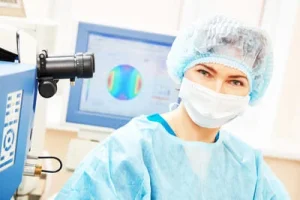
Over the past few decades, laser eye surgery has evolved from a relatively straightforward laser treatment into a highly precise, individually planned technological procedure.
This transformation was not driven by laser technology alone. Advances in diagnostic imaging, eye-tracking systems, computer processing, treatment-planning software and femtosecond laser technology have all played an important role.
A modern refractive laser platform is therefore much more than a laser. It is an integrated technological system designed to analyse the individual eye, calculate a treatment plan and deliver laser energy with a very high degree of precision.
From Early Laser Correction to Digital Precision

The development of refractive laser surgery began with the excimer laser.
Excimer technology made it possible to reshape the cornea with remarkable control and became the technological foundation of modern laser vision correction.
Early systems, however, relied largely on conventional refractive measurements. The treatment plan was primarily based on sphere, cylinder and axis.
As diagnostic technology improved, it became increasingly clear that the optical characteristics of the eye are considerably more complex than these three parameters.
This led to a major shift in refractive technology: from standardised correction towards individualised optical treatment.
Wavefront Analysis and Aberrometry

One of the important technological steps in this evolution was the development of aberrometry and wavefront analysis.
These technologies can identify not only conventional refractive errors but also more subtle optical imperfections known as higher-order aberrations.
This created the possibility of designing treatments around the individual optical characteristics of an eye rather than relying exclusively on conventional prescription values.
The philosophy of laser vision correction therefore gradually changed from correcting a prescription to analysing an optical system.
Topography and Tomography
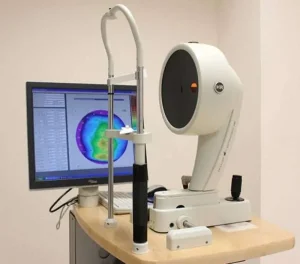
At the same time, corneal diagnostic systems became increasingly sophisticated.
Modern corneal topography and tomography can provide detailed information about the shape and structure of the cornea. Depending on the diagnostic platform, this may include surface geometry, thickness distribution and three-dimensional structural information.
This is particularly important in refractive surgery.
A modern laser treatment does not begin with the laser itself. It begins with diagnostics.
The measurements help the surgeon determine whether a particular procedure is appropriate and which technological approach may be suitable for the individual eye.
Eye-Tracking Technology
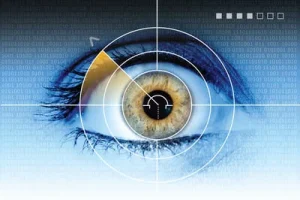
Another major development has been the increasing sophistication of eye-tracking systems.
The eye is not completely motionless during a procedure. Even with good fixation, small movements can occur.
Modern laser platforms are designed to detect such movements and adjust the position of the treatment accordingly.
High-speed imaging, motion detection and computer-controlled laser delivery therefore work together to keep the treatment aligned with the planned treatment zone.
Eye tracking has become an important part of modern laser platforms because precision is not only about where the laser is programmed to work, but also about maintaining that position throughout the procedure.
The Femtosecond Laser Revolution
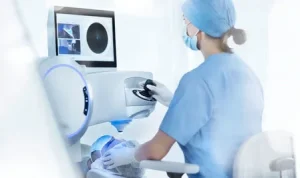
The excimer laser and the femtosecond laser perform fundamentally different technological tasks.
A femtosecond laser uses extremely short laser pulses to create precisely defined planes within the corneal tissue.
This represented a significant technological step in corneal surgery.
Instead of relying solely on mechanical instruments or surface-based tissue removal, surgeons could increasingly work with precisely programmed three-dimensional laser cuts inside the cornea.
Corneal surgery consequently became more computer-controlled and geometrically defined.
The Evolution of LASIK Platforms
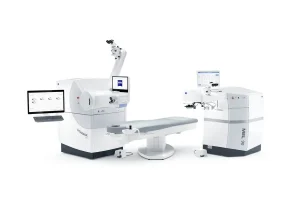
The combination of femtosecond and excimer laser technology led to highly sophisticated LASIK platforms.
In these systems, the femtosecond laser is used to create the corneal flap, while the excimer laser performs the refractive correction.
Over successive generations, the systems became faster and more precise. Treatment planning, diagnostic integration, laser control and safety monitoring also improved.
Importantly, technological progress did not occur inside the laser source alone.
Computer hardware, imaging technology and software became equally important components of the overall system.
SMILE and the Development of Lenticule Technology
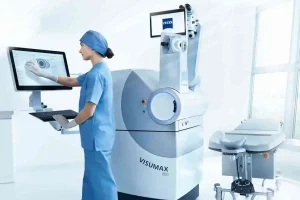
One of the most significant technological developments of recent years has been lenticule-based laser surgery.
In SMILE, a femtosecond laser creates a precisely defined piece of corneal tissue, known as a lenticule, inside the cornea. The lenticule is then removed through a small access incision.
From a technological perspective, this represents a different approach from procedures that rely on creating a larger corneal opening followed by surface-based tissue ablation.
The development of SMILE illustrates a broader change in refractive surgery: from predominantly surface-oriented laser ablation towards three-dimensional tissue modelling and removal within the cornea.
SMILE Pro and Next-Generation Femtosecond Platforms
SMILE Pro: Newer femtosecond laser platforms have continued to develop this concept.
Higher repetition rates, faster laser delivery, improved imaging and increasingly sophisticated software have contributed to more efficient treatment workflows.
Speed is an important part of this development, but it should not be considered in isolation.
The real technological advance lies in the interaction between the laser source, optical system, imaging technology, motion control, software and surgical planning.
A faster laser is useful, but a modern refractive platform is defined by how well all of these components work together.
Software Has Become a Core Part of the Laser
Modern refractive surgery would be difficult to imagine without sophisticated software.
Software systems process diagnostic information, calculate treatment parameters and control laser delivery.
Depending on the platform, different types of diagnostic data can be incorporated into the treatment-planning process.
This has changed the role of technology in refractive surgery.
The laser does not decide which treatment a patient should receive. That remains a medical decision made by the surgeon.
Technology, however, allows that decision to be implemented using a much larger and more detailed set of measurements.
From Standardised Treatment to Individualised Planning
Perhaps the most important development in refractive laser technology is therefore not a single new laser.
It is individualisation.
Earlier generations had to work with relatively limited parameters. Modern platforms can incorporate significantly more information about the individual eye.
Depending on the technology available, this may include corneal shape, corneal thickness, optical aberrations, pupil behaviour, eye movements and other measurements.
Refractive surgery is consequently becoming increasingly data-driven.
What Comes Next?
The development of refractive laser technology is far from finished.
Future progress is likely to involve even closer integration between diagnostic imaging, automated treatment planning, artificial intelligence and laser control.
Real-time analysis may also become increasingly important, particularly as imaging systems become faster and more capable of identifying changes during treatment.
The technological workflow can therefore be viewed as a continuous chain:
Measure → Analyse → Plan → Treat → Verify
The better these individual stages communicate with one another, the more precisely treatment can potentially be adapted to the anatomy and optical characteristics of each eye.
Conclusion

The history of laser eye technology is not simply a story of increasingly powerful or faster lasers.
It is a story of increasing precision.
The original excimer laser has evolved into a sophisticated ecosystem combining femtosecond technology, advanced diagnostics, eye tracking, imaging, computer processing and treatment-planning software.
Modern systems can analyse the eye in considerably greater detail and use this information to develop highly individualised treatment strategies.
The next generation of refractive surgery may therefore be defined less by one revolutionary laser and more by the integration of multiple technologies into a single intelligent platform.
The future of laser eye surgery will not depend on the laser alone. It will depend on how intelligently diagnostics, software and laser technology work together.

At Lasikwelt Eye Laser Centre, we use some of the most advanced technologies currently available in refractive eye surgery. Our goal is not simply to offer as many procedures as possible, but to give our patients access to state-of-the-art technology and combine it with precise, individually planned treatment. Modern diagnostics, advanced laser platforms and careful medical planning work together to create a treatment approach tailored to each individual eye. For us, technology is not an end in itself—it should provide a genuine clinical benefit for the patient.
At the same time, we believe that access to leading laser eye technology should not be limited to those willing or able to pay premium prices. That is why we aim to offer state-of-the-art technology at fair and attractive prices. Affordable does not mean compromising on technology or medical standards. It means creating the best possible balance between advanced technology, medical expertise, safety and cost. High-end technology should not require a high-end price. This is what Lasikwelt Augenlaser-Zentrum stands for.


