Medically reviewed by Dr Susanne Öner
Specialist in ophthalmology · Last medical review: 21 September 2026
This page provides general information and does not replace an individual eye examination or personal medical advice.
In brief: PRESBYOND® Laser Blended Vision is a personalised FemtoLASIK-based treatment designed to address
presbyopia. The dominant eye is usually optimised primarily for distance, while the non-dominant eye is given a mild degree of short-sightedness to support near vision. A customised aspheric ablation profile also extends the depth of focus in both eyes. The aim is to create a smooth binocular range of vision from near through intermediate to distance. PRESBYOND does not restore the eye’s natural accommodation, however, and cannot guarantee complete or lifelong freedom from glasses.
Procedurepersonalised FemtoLASIK
Visual rangenear, intermediate and distance
Natural lensremains in the eye
Key factorssuitability and binocular tolerance
What is PRESBYOND Laser Blended Vision?
As we age, the natural lens of the eye gradually loses flexibility. It becomes less able to change focus for close work. This normal age-related change is known as presbyopia and usually becomes noticeable during the forties or early fifties.
PRESBYOND is not lens surgery. It is a corneal laser procedure that combines a personalised aspheric treatment profile with carefully planned micro-monovision:
- The dominant eye is generally targeted for clear distance vision.
- The non-dominant eye is left mildly short-sighted by an individually selected amount to support near vision.
- Both eyes receive a customised ablation profile designed to increase depth of focus.
- The brain is expected to integrate the visual ranges of both eyes into a useful binocular image.
Treatment planning takes account of the starting prescription, the functional age of the eye, pupil size, preoperative wavefront data and the difference between the eyes that the individual patient can comfortably tolerate. ZEISS therefore describes PRESBYOND as an advanced binocular vision concept rather than simple conventional monovision. Official ZEISS information about PRESBYOND.
PRESBYOND does not reverse ageing of the natural lens
Reshaping the cornea can extend the functional range of vision, but it cannot make the natural lens flexible again. The lens continues to age and may later develop cataract. Even after a successful procedure, glasses may still be useful or necessary for very small print, dim lighting or specific visual tasks.
How does PRESBYOND work and what does treatment involve?
The surgical technique is based on FemtoLASIK. A femtosecond laser creates a thin corneal flap. The ZEISS MEL 90 excimer laser then reshapes the cornea according to the individually calculated PRESBYOND profile. Finally, the flap is returned to its original position.
1
Detailed preoperative assessment
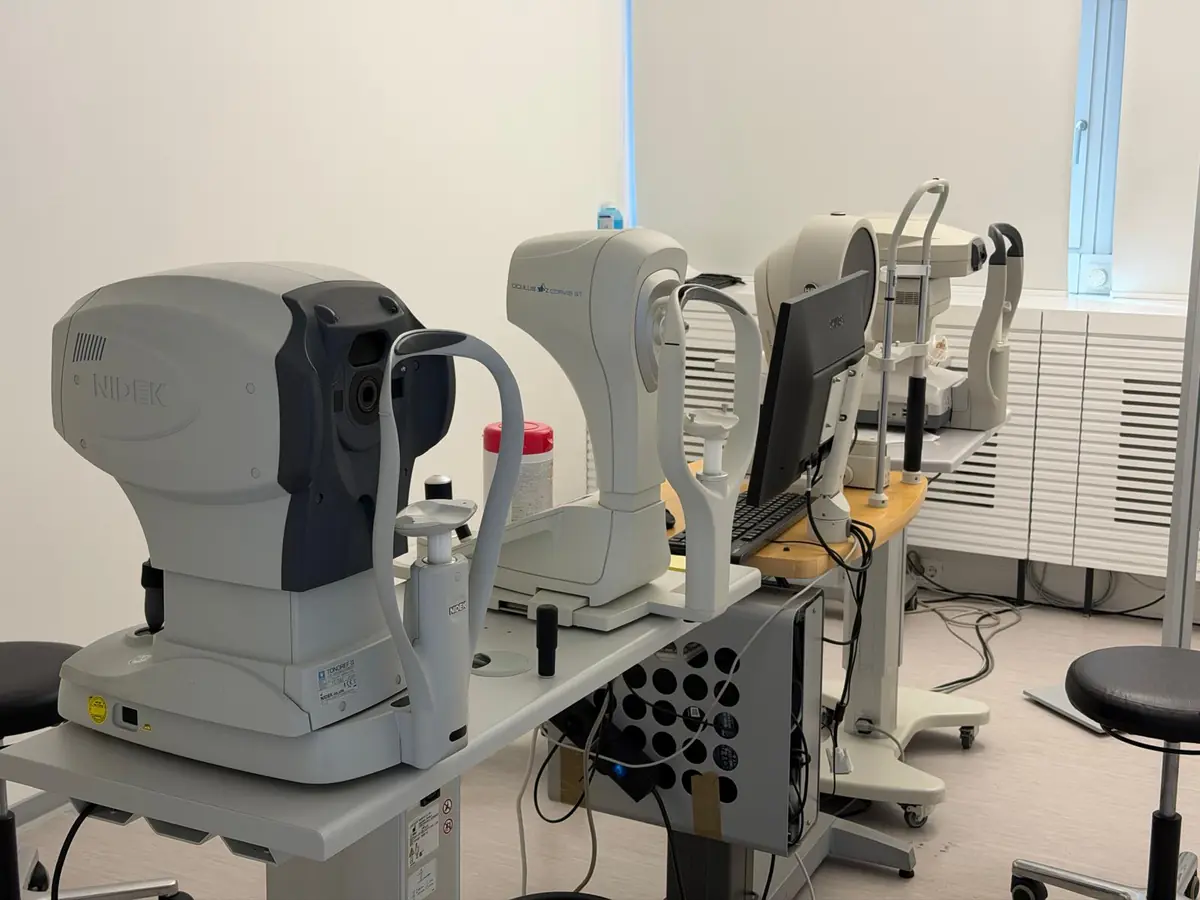
The examination includes the prescription, corneal thickness, corneal topography and tomography, pupil size, tear film, intraocular pressure, retina and natural lens. Eye dominance, near-vision requirements and tolerance of the intended micro-monovision are also assessed.
Read more about the examination before laser eye surgery
2
Personalised binocular planning
The target refraction is not chosen from a fixed template. Planning considers age, starting prescription, visual habits, professional demands, pupil size, wavefront data and the amount of difference between the eyes that feels comfortable. A realistic balance between near vision and the quality of distance and low-light vision is particularly important.
3
Outpatient FemtoLASIK procedure
The eye is numbed with anaesthetic drops. Creation of the flap and the excimer-laser treatment each take only a short time, although the complete appointment is longer because of preparation and the surgical steps. Pressure or a sensation of touch may be noticed, but patients usually do not experience surgical pain.
What to expect on the day of laser eye surgery
4
Healing and neurovisual adaptation
Visual acuity often improves quickly, but the way the distance and near eyes work together may take time to feel natural. During this adaptation period, vision can fluctuate and some patients notice dry eyes, halos or temporarily unfamiliar visual perception. Eye drops and follow-up appointments should be used exactly as advised.
Advice after laser eye treatment
Who may be suitable for PRESBYOND?
Suitability cannot be decided from age or prescription alone. It depends on the combined findings for eye health, corneal parameters, the condition of the natural lens, binocular function and the patient’s own visual priorities.
Features that may support suitability
- noticeable presbyopia and a wish to reduce dependence on glasses
- a sufficiently stable prescription
- adequate corneal thickness and a regular corneal shape
- a healthy or adequately treated ocular surface
- no clinically relevant lens opacity
- adequate tolerance of the proposed micro-monovision
- realistic expectations for near, intermediate and distance vision
Possible exclusions or risk factors
- keratoconus or another progressive corneal disorder
- insufficient corneal tissue for safe treatment
- significant dry-eye disease that has not been adequately controlled
- symptomatic cataract
- relevant retinal, macular or optic-nerve disease
- poorly controlled glaucoma or an unstable systemic condition
- insufficient binocular tolerance
Why the preoperative examination matters so much
When considering a procedure for presbyopia, assessing only the cornea and prescription is not enough. The condition of the natural lens is equally important. If clinically significant lens opacity is already present, corneal laser treatment may not be the most appropriate option and a lens-based procedure may make more medical sense.
The recommendations of the German Commission for Refractive Surgery list FemtoLASIK or LASIK as possible monovision treatments when presbyopia is present. They also emphasise careful patient selection and the general contraindications that apply to corneal refractive surgery. German Commission for Refractive Surgery recommendations, May 2024.
Important: High suitability or success rates reported in manufacturer information or clinical studies should not be applied automatically to an individual patient. A personal recommendation is only possible after a complete examination and assessment of binocular tolerance.
Results, potential benefits and possible risks
In carefully selected patients, PRESBYOND may improve functional vision at near, intermediate and distance and reduce reliance on reading or varifocal glasses. The outcome is influenced by the starting prescription, corneal shape and thickness, ocular surface, natural lens, personal visual requirements, healing response and neurovisual adaptation.
| Feature |
PRESBYOND Laser Blended Vision |
Conventional monovision |
Refractive lens exchange |
| Basic principle |
Aspheric corneal treatment combined with individually adjusted micro-monovision |
One eye mainly for distance and the other mainly for near |
The natural lens is replaced with an artificial intraocular lens |
| Natural lens |
remains in place |
remains in place |
is removed |
| Intermediate vision |
planned binocular overlap zone |
may be limited depending on the targets selected |
depends on the lens technology used |
| Invasiveness |
corneal procedure involving a FemtoLASIK flap |
corneal procedure or contact-lens simulation, depending on the approach |
intraocular surgery |
| Future lens ageing |
continues |
continues |
cataract of the natural lens can no longer develop |
What does current clinical evidence show?
Recent six-month outcomes: A retrospective study published in 2026 included 125 patients. After the initial treatment, 94.4% reported improved visual function and reduced dependence on spectacles. Enhancement treatment was required in 5.3% of the myopic group and 12.6% of the hyperopic group. The study was non-comparative and follow-up was limited to six months.
Wong et al., Journal of Refractive Surgery, 2026.
Newer long-term data: A separate retrospective study published in 2026 evaluated 100 patients followed for 15 to 59 months. Overall, 72% were satisfied and most remained largely independent of spectacles. However, 21% underwent an enhancement procedure, and hyperopic patients more often reported visual symptoms, enhancement treatment and lower subjective satisfaction. The authors therefore stressed careful selection and realistic counselling.
Trojacka et al., long-term PRESBYOND outcomes, Journal of Clinical Medicine, 2026.
Earlier clinical reports also describe useful functional outcomes in myopic, hyperopic and emmetropic patients with presbyopia. Most of the available publications are observational studies from specialist centres, however, so their results should not be interpreted as a guarantee for an individual patient. See the three-year data on Laser Blended Vision and clinical outcomes of non-linear aspheric micro-monovision.
Potential benefits
- reduced dependence on reading or varifocal glasses
- a binocular concept intended to create overlap between near, intermediate and distance vision
- individually calculated refractive targets and aspheric ablation
- preservation of the natural lens
- outpatient treatment with generally rapid functional visual recovery
Possible risks and limitations
PRESBYOND is a surgical procedure and is not risk-free.
Possible effects include dry eyes, fluctuating vision, halos, glare sensitivity, reduced contrast perception, temporarily unfamiliar depth perception, undercorrection or overcorrection, regression and the need for an enhancement procedure. Rare FemtoLASIK-specific complications may include flap folds, epithelial ingrowth, inflammation, infection or corneal ectasia.
Neurovisual adaptation varies from one person to another. Not every patient tolerates the intended difference between the eyes equally well. Complete freedom from glasses or a particular visual result cannot be guaranteed.
Detailed information about laser eye surgery risks, side effects and complications
PRESBYOND cost, assessment and treatment at LASIKWELT Cologne
€1,750*
per eye
Financing may be available from €33 per month
Financing may be available depending on the term, amount financed, credit assessment and the finance provider’s conditions. Information about laser eye surgery financing.
Why choose LASIKWELT Laser Eye Centre in Cologne?
- personalised refractive and binocular treatment planning
- ZEISS VISUMAX 800 and ZEISS MEL 90 technology
- detailed corneal and ocular-surface diagnostics
- experienced ophthalmic surgeons listed by the German Commission for Refractive Surgery
- transparent pricing and structured follow-up care
- a central location in Cologne city centre
LASIKWELT Laser Eye Centre
Herzogstraße 32
50667 Cologne
Telephone: 0221 2725 3333
Frequently asked questions about PRESBYOND
Will I never need reading glasses again after PRESBYOND?
The aim is to reduce dependence on glasses substantially. Reading glasses may still be helpful or necessary for very small print, difficult lighting conditions or specialised visual tasks.
How long does the result last?
The laser-induced change in corneal shape is intended to be permanent. The natural lens and other structures of the eye continue to age, however. Near-vision requirements, prescription and visual quality may therefore change over time, and cataract can still develop.
When can I drive again?
You should drive only when your vision is adequate and the treating ophthalmologist has confirmed this at a follow-up examination. The timing depends on individual healing and neurovisual adaptation.
Is PRESBYOND better than refractive lens exchange?
There is no universal answer. PRESBYOND preserves the natural lens and does not involve intraocular surgery. If clinically relevant lens opacity is already present, or in certain other situations, a lens-based procedure may be more appropriate. The decision requires assessment of the cornea, lens, retina and individual visual goals.
Could I need an enhancement?
Yes. Enhancement treatment may be considered if residual refractive error, regression or an unsatisfactory balance between the distance and near eyes remains. It is only possible when the medical requirements for further treatment are met.
Sources and medical literature
Author and medical reviewer
Dr Susanne Öner
Specialist in ophthalmology · Medically reviewed and last updated on 21 September 2026.

 Deutsch