
 Deutsch
Dry Eyes After Laser Eye Surgery
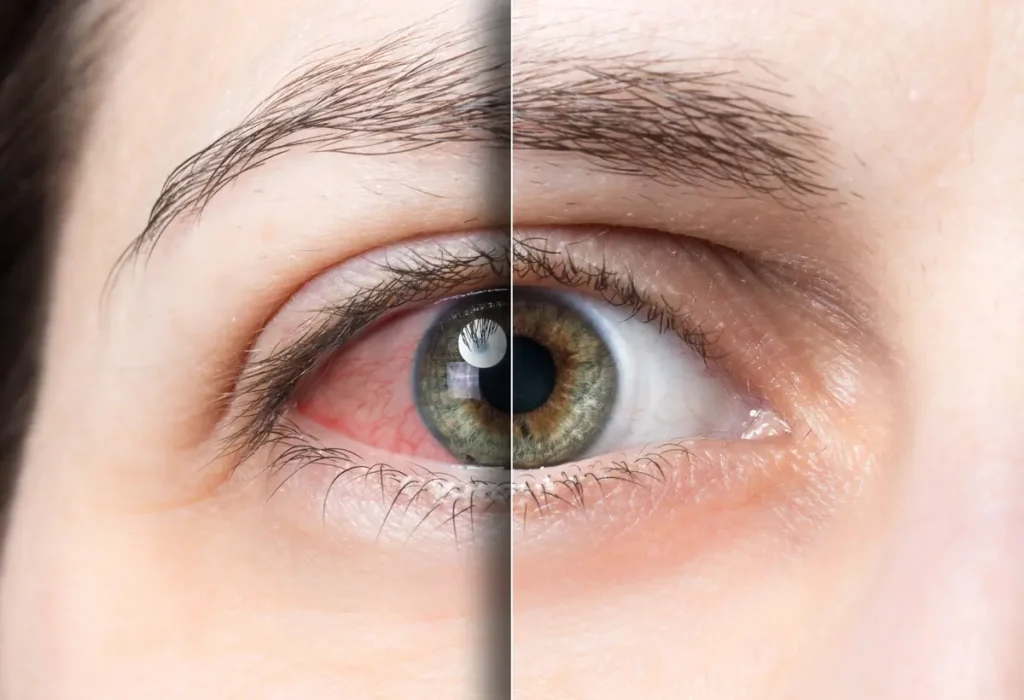
Dry-eye symptoms can occur after laser eye surgery, whether the procedure is SMILE Pro, FemtoLASIK or PRK. For most affected patients, symptoms are most noticeable during the first weeks or months and improve as healing progresses. Evidence published in 2025 and 2026 suggests that the ocular surface often remains more stable in the early recovery period after small-incision lenticule extraction, such as SMILE, than after FemtoLASIK. This is not an absolute advantage, however, and the difference may become smaller over time.
The name of the procedure is therefore only part of the picture. The condition of the tear film, eyelid margins and meibomian glands before surgery, a thorough preoperative laser eye surgery examination, appropriate procedure selection and structured aftercare are at least as important.
Key points
- Every corneal laser vision correction procedure can temporarily affect the tear film and corneal sensitivity.
- Many people already have unrecognised or mild ocular-surface abnormalities before surgery.
- A 2025 meta-analysis of 18 studies found better early tear-film stability and corneal sensitivity after SMILE/KLEx than after FemtoLASIK. The difference in patient-reported symptoms was much less clear.
- A prospective 2025 comparison found no difference in subjective or objective dry-eye measures at 12 months.
- Percentages from different studies are not directly interchangeable because symptoms, clinical measurements and diagnoses recorded in medical charts measure different things.
- Pre-existing dry-eye disease should be identified and, where possible, stabilised before elective laser eye surgery.
Why can the eyes become drier after laser eye surgery?
The cornea is one of the most densely innervated tissues in the body. Its nerves detect changes at the ocular surface and help regulate tear production, blinking and protection of the corneal epithelium. When surgery temporarily alters this feedback loop, tear secretion, blink frequency and tear-film stability may decrease.
Normal wound healing and inflammation, changes to the corneal surface and the eye drops used during recovery can also contribute. Pre-existing meibomian gland dysfunction, blepharitis or contact-lens intolerance may become more noticeable after surgery. In that situation, the procedure is not necessarily the sole cause; it may reveal an ocular-surface problem that had previously been partly compensated.
For a general overview of causes, symptoms and treatment options unrelated to a particular operation, see our guide to dry eyes: causes, symptoms and treatment.
SMILE Pro
During SMILE Pro laser eye surgery, a lenticule is removed through a small corneal incision. No LASIK flap is created. This generally disrupts fewer nerve fibres in the anterior cornea than a wide flap, helping to explain why comparative studies often find faster early recovery of corneal sensitivity and tear-film measures after SMILE/KLEx. SMILE Pro does not eliminate the possibility of dry eyes.
FemtoLASIK
In FemtoLASIK, a femtosecond laser creates a thin corneal flap and an excimer laser reshapes the underlying tissue. Creating the flap affects a wider area of the anterior corneal nerves. Dryness, a gritty sensation and fluctuating vision are therefore recognised early postoperative effects. FemtoLASIK nevertheless remains a modern, established procedure and may be the more suitable method for certain eyes.
PRK and other surface procedures
PRK laser eye surgery does not involve a flap. Instead, the corneal epithelium is removed and then regrows. This initial healing phase is usually longer and less comfortable than after SMILE Pro or FemtoLASIK. A surface procedure therefore does not automatically prevent postoperative dry eye.
How common are dry eyes after laser eye surgery?
There is no single scientifically sound percentage that applies to every patient. The reason is not simply conflicting evidence: studies ask different questions. Some count even mild symptoms on a questionnaire, others require abnormal clinical tests, while registry studies capture only diagnoses entered into the medical record. The point in time at which patients are assessed also has a major effect on the result.
| Study | Population and method | Main finding | How to interpret it |
|---|---|---|---|
| Cartes et al., 2024 | 135 LASIK candidates received an extensive preoperative ocular-surface examination | Depending on the diagnostic criteria, 25.9% or 53.3% met the definition of dry-eye disease. | A small, single-centre study. Its main value is showing that abnormalities may already be present before surgery and that the definition strongly affects prevalence. |
| Wu et al., 2026 | 3,000 patients after FemtoLASIK; dry eye defined using OSDI symptoms | 25% at one week, 38% at one month and 15% at three months; cases were predominantly mild to moderate. | Very recent but retrospective, single-centre data with only three months of follow-up. The figures describe symptoms, not necessarily persistent disease. |
| Kang et al., 2026 | 48,892 eyes in the US IRIS Registry after LASIK or PRK | A dry-eye diagnosis was documented during follow-up in 16.1% of LASIK eyes and 15.6% of PRK eyes. The rate was higher after PRK between months 1 and 3. | Large real-world dataset, but dependent on clinical coding; mild or undocumented symptoms may be missed. |
| Beckers et al., 2026 | 916 eyes after SMILE Pro with the ZEISS VISUMAX 800; retrospective case series | Dry eye was recorded as a postoperative event in 1.32% before three months and 1.65% after three months. | These are documented postoperative events, not systematically measured symptom prevalence. They support a favourable early safety profile but do not replace long-term data. |
Important: The table does not provide a personal risk prediction. Instead, it shows why claims such as “everyone develops dry eye” or “the risk is exactly x%” are not scientifically defensible.
What do direct comparisons of SMILE and FemtoLASIK show?
Recent publications increasingly use keratorefractive lenticule extraction (KLEx) as an umbrella term for small-incision corneal lenticule procedures. SMILE and SMILE Pro are part of this group.
A 2025 meta-analysis of 18 comparative studies found a longer mean tear break-up time at three and six months and better early recovery of corneal sensitivity after KLEx than after FemtoLASIK. Differences in Schirmer testing were small, and there was no statistically significant advantage in patient-reported OSDI symptoms. Objective findings and a person’s experience do not always move in parallel.
A small 2026 contralateral-eye study compared one KLEx-treated eye with the fellow FemtoLASIK-treated eye in 17 people. After a mean of 34 days, tear osmolarity, tear break-up time and symptoms were more favourable on the KLEx side. Comparing the two eyes of the same person reduces between-patient differences, but the small sample and short follow-up limit how far the result can be generalised.
For longer-term interpretation, a 2025 prospective fellow-eye study of 40 people is particularly relevant: at 12 months, there was no difference between topography-guided LASIK and KLEx in subjective or objective dry-eye measures. Taken together, the evidence supports an early ocular-surface advantage for small-incision lenticule extraction—not a promise that dry eye never occurs after SMILE.
Who is at greater risk?
Individual risk reflects several factors. Particular attention is warranted when there is:

- existing burning, grittiness, fluctuating vision or frequent use of lubricating drops;
- an unstable tear film, corneal staining or meibomian gland dysfunction;
- blepharitis, incomplete eyelid closure or another ocular-surface disorder;
- long-term contact-lens wear or marked contact-lens intolerance;
- certain autoimmune diseases, diabetes, hormonal factors or medicines that may affect the tear film or healing;
- long periods of screen use, dry indoor air, and infrequent or incomplete blinking.
In the 2026 FemtoLASIK study of 3,000 patients, pre-existing dry-eye disease was the strongest independent predictor of early postoperative symptoms. This supports a practical principle: the best opportunity to reduce postoperative problems often comes before surgery.
How should the ocular surface be assessed before surgery?
The TFOS DEWS III report published in 2026 emphasises that dry-eye disease is multifactorial. No single measurement can therefore provide a complete assessment. Depending on the findings, preoperative evaluation may include:
- targeted questions about symptoms, contact lenses, screen work, medical conditions and medicines;
- examination of the eyelid margins, eyelid closure and meibomian glands;
- assessment of tear-film stability, for example tear break-up time;
- corneal and conjunctival staining to detect surface damage;
- measurement of tear quantity or additional tests when they answer a specific clinical question;
- confirmation that measurements are stable and repeatable after an individually determined break from contact lenses.
A stable tear film matters for more than comfort: it is the eye’s first optical surface. If it is irregular, visual acuity and preoperative measurements can fluctuate. Ocular-surface assessment is therefore part of accurate treatment planning, not merely a check for possible side effects. See laser eye surgery methods, recovery and suitability for an overview of the full eligibility process.
Can the risk be reduced?
- Identify problems before surgery: mention symptoms even if they occur only in the evening, during screen use or with contact lenses.
- Stabilise the ocular surface first: blepharitis, meibomian gland dysfunction, allergy or an unstable tear film should be managed according to the cause. Elective surgery can be postponed until measurements are reliable.
- Select the procedure from the whole examination: increased dry-eye risk may favour SMILE Pro, but it is not the only deciding factor. Refractive error, corneal shape, tissue reserve, age and visual goals must also be suitable.
- Use eye drops exactly as prescribed: the type, frequency and duration of treatment require clinical guidance. Prescription anti-inflammatory drops or steroids should never be started, changed or stopped without the treating clinician.
- Limit evaporation in daily life: deliberate complete blinking, regular screen breaks and avoiding heating or air-conditioning directed at the face may ease symptoms. These measures do not replace medical treatment.
- Attend follow-up appointments: planned examinations remain important even when vision is good. See our guide to aftercare following laser eye surgery.
How long do dry eyes last after laser eye surgery?
Symptoms are typically most noticeable in the early healing phase and then decline. The recent FemtoLASIK study of 3,000 patients showed a clear reduction by the third month. Direct comparative evidence also indicates that differences between procedures can narrow with time.
Recovery is individual, however. A symptom that remains at three months is not automatically permanent, but it should be investigated rather than managed simply by using drops more and more often. Possible explanations include persistent ocular-surface disease, meibomian gland dysfunction, incomplete eyelid closure, allergy, residual refractive error or—much less commonly—a neuropathic pain component.
When should you contact an eye doctor urgently?
Dryness, mild burning or fluctuating vision can occur during early recovery. The following changes require prompt ophthalmic assessment:
- increasing or severe pain;
- sudden or progressive loss of vision;
- worsening redness or pus-like discharge;
- marked sensitivity to light;
- an injury or impact to the operated eye;
- new flashes, shadows or missing areas in the visual field.
These symptoms should not be dismissed as “just dry eye”. Read more about laser eye surgery risks, side effects and complications.
Frequently asked questions
Can I have laser eye surgery if I already have dry eyes?
It depends on the cause, severity and how well the condition can be controlled. A mild, treatable problem does not automatically exclude surgery. Severe or unstable dry-eye disease may require treatment to be postponed or may lead to a recommendation against corneal laser surgery.
Does SMILE Pro cause fewer dry-eye problems than FemtoLASIK?
Current comparative evidence supports better early recovery of tear-film measures and corneal sensitivity after SMILE/KLEx. The difference in patient-reported symptoms is less certain and may no longer be present at 12 months. SMILE Pro may reduce risk in some patients, but it does not remove it.
Can dry eyes after laser eye surgery be permanent?
Early symptoms improve during healing for most patients. Persistent symptoms can occur and deserve a targeted assessment. Population-level studies cannot reliably predict the duration for an individual person.
Can screen use make symptoms worse?
Yes. Concentrated screen work often reduces blink frequency and increases tear evaporation. It can aggravate symptoms, but it is not the sole explanation for dry eye after surgery.

Which eye drops are best after laser eye surgery?
The choice depends on the procedure, clinical findings and stage of healing. Lubricating drops are commonly used; inflammation or another underlying cause may require additional treatment. The treating eye doctor should determine the specific product and dosing schedule.
Is a normal Schirmer test enough?
No. A single test can neither reliably exclude dry-eye disease nor fully explain it. Symptoms, tear-film stability, surface staining, the eyelid margins and meibomian glands need to be interpreted together.
Conclusion: a stable ocular surface is part of safe treatment planning
Research published in 2025 and 2026 paints a nuanced picture. SMILE/KLEx often provides an early advantage over FemtoLASIK in tear-film stability and corneal sensitivity, while longer-term differences may diminish. No method replaces careful screening, and no single study can provide a personal risk percentage.
At LASIKWELT, the choice between SMILE Pro and FemtoLASIK should therefore not be based on the procedure name alone. Only an assessment of the cornea, tear film, ocular surface, refractive error and individual visual needs can show which option is medically appropriate—or whether treatment should be postponed.
Medical sources and further reading
- TFOS DEWS III Report: current evidence on the definition, diagnosis and management of dry-eye disease (2026)
- Chen et al.: KLEx versus FemtoLASIK — systematic review and meta-analysis of 18 studies (2025)
- Küçüködük and Aksoy: early dry eye after KLEx versus FemtoLASIK in a contralateral-eye comparison (2026)
- Sitto et al.: prospective 12-month comparison of topography-guided LASIK and KLEx (2025)
- Wu et al.: prevalence and predictors of early dry-eye symptoms after FemtoLASIK in 3,000 patients (2026)
- Kang et al.: dry eye, visual disturbance and pain after LASIK versus PRK in the IRIS Registry (2026)
- Beckers et al.: safety and postoperative events after SMILE Pro in 916 eyes (2026)
- Cartes et al.: prevalence of dry-eye findings in LASIK candidates before surgery (2024)
Author: LASIKWELT Editorial Team
Last updated: September 2026
This article provides general medical information and is not a substitute for an individual eye examination or treatment recommendation.


