
 Deutsch
PRK (Photorefractive Keratectomy) Laser Eye Surgery
After a PRK laser eye treatment, careful aftercare is crucial for healing and the final quality of vision.
Free info kit
Free quick check

After a PRK laser eye treatment, careful aftercare is crucial for healing and the final quality of vision.
Free info kit
PRK (Photorefractive Keratectomy) is a specialized form of laser eye surgery designed to correct common vision defects, including nearsightedness (myopia), farsightedness (hyperopia), and astigmatism. This procedure is particularly beneficial for individuals who may not be suitable candidates for other types of laser eye surgeries, such as LASIK / FemtoLASIK, Relex SMILE / SMILE Pro

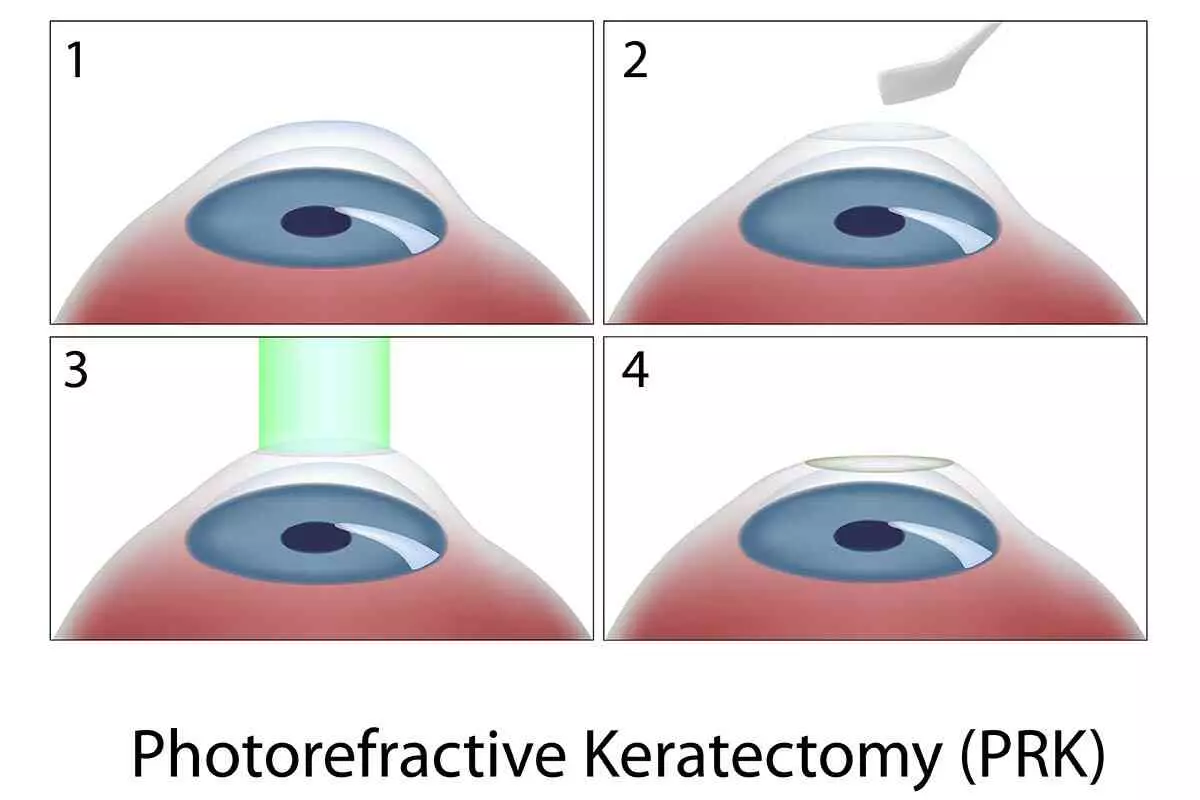
Unlike the more well-known FemtoLASIK / LASIK method, which involves creating a thin flap in the cornea, PRK completely removes the top layer of the cornea (the epithelium) before reshaping the underlying area with an excimer laser to correct the eye’s refractive power.
The main difference between PRK and LASIK is how access to the corneal layer to be reshaped is created. In PRK, there is no flap creation, which reduces the risk of complications related to a corneal flap. However, the recovery time after PRK can be longer and more uncomfortable than after LASIK, as the removed epithelial layer takes a few days to regenerate.
PRK, photorefractive keratectomy, is a laser eye treatment for correcting refractive errors. The process begins with a comprehensive pre-examination to determine the patient’s suitability. The actual treatment is performed on an outpatient basis and under local anesthesia with eye drops. During the procedure, the ophthalmologist removes the top layer of the cornea, the epithelium, and then reshapes the underlying corneal layer with an excimer laser to correct the specific vision defects.


After the laser treatment, a protective contact lens is placed on the eye to support the healing process and reduce pain. The healing process takes a few days, during which there may be discomforts such as light sensitivity or a foreign body sensation. Regular follow-up appointments are essential to monitor the healing process and ensure the best possible visual outcome.
Photorefractive keratectomy (PRK) is a form of laser eye treatment that includes various variants. These variants have been developed to correct different vision problems and adapt the treatment to the specific needs and conditions of the patients. Here are some of the most well-known types of PRK:
Each of these PRK variants has specific advantages and can be recommended depending on the individual needs and conditions of the patient, including corneal thickness, type and degree of vision defects, and overall eye health. The choice of the appropriate method should always be made in close consultation with a qualified ophthalmologist to determine the best option for safe and effective vision correction.
This method is an alternative to FemtoLASIK / LASIK treatment and is particularly suitable for patients with thin corneas. One of the main advantages of PRK is that no corneal flap is created, which reduces the risk of complications. While the healing phase may be longer than with LASIK, the end result is stable vision correction. PRK can also be used for patients who perform certain professional activities or lead active lifestyles where there is a risk of displacing the flap. Additionally, PRK minimizes the likelihood of dry eyes after surgery, leading to higher patient satisfaction. However, with the invention of the SMILE Pro / Relex SMILE laser eye method, the necessity for PRK has almost diminished.
PRK (Photorefractive Keratectomy) offers many patients a solution for correcting vision defects but, like any surgical procedure, comes with certain disadvantages and risks. Here are some of the most common disadvantages and risks associated with the PRK laser eye method:
A thorough pre-examination and consultation with a qualified ophthalmologist can help minimize the risk of complications and ensure that PRK is the best option for the individual needs and conditions of the patient.
Careful aftercare is crucial for the healing process and the final visual performance after a PRK (Photorefractive Keratectomy) laser eye treatment. The recovery time after PRK varies, with most patients needing several days to weeks for complete healing.
In the immediate phase after the surgery, you may experience mild discomfort or pain. Your doctor will prescribe special eye drops to reduce inflammation and promote healing. It is important to protect the eyes from light in the first few days after the surgery and avoid physical exertion.
Consistent aftercare, including regular appointments with the ophthalmologist, is essential for monitoring your healing. During these appointments, the doctor can assess the healing process and make adjustments to your treatment if necessary.
Full restoration of vision can take several weeks, and it is important to be patient and follow your ophthalmologist’s instructions carefully.
PRK (Photorefractive Keratectomy) is a method for correcting vision defects. Here are some frequently asked questions about PRK treatment that patients often have:
The main difference between PRK and LASIK is how access to the cornea is created. In the PRK procedure, the ophthalmologist first removes the thin, outermost layer of the cornea, known as the epithelium. This removal is performed to allow direct access to the underlying corneal tissue. Once the epithelium is completely removed, an excimer laser is then used to precisely reshape the corneal stroma, the middle layer of the cornea, to correct the refractive error. This reshaping process helps to focus light more accurately onto the retina, thereby improving vision clarity.
In LASIK, a thin flap is created in the cornea to treat the underlying area. PRK has a longer healing time but can be a safer option for some patients, especially those with thin corneas.
Healing after PRK can vary, but many patients notice a significant improvement in their vision within the first week. However, full healing and stabilization of vision can take several weeks to months. The first few days after the surgery can be particularly uncomfortable as the epithelium heals.
During the PRK treatment itself, most patients feel no pain as numbing eye drops are used. After the treatment, once the numbing effect wears off, patients may experience discomfort or pain for a few days while the epithelium heals.
As with any surgical procedure, there are risks with PRK, including infections, corneal clouding (haze), under- or overcorrection of vision, and, rarely, permanent vision problems such as reduced contrast sensitivity or glare sensitivity. Overall, the risks are low, but a detailed discussion with the ophthalmologist can help understand them.
The vision correction achieved with PRK is typically permanent. However, age-related changes such as the development of presbyopia (age-related farsightedness) or changes in corneal structure over time may require additional vision aids.
Good candidates for PRK are individuals with moderate to severe myopia, hyperopia, or astigmatism who have stable vision. People with thin corneas who may not be suitable for LASIK can be particularly good candidates for PRK. A comprehensive eye examination is necessary to determine suitability.
A full eye examination is necessary before PRK. The ophthalmologist may give specific instructions, such as avoiding contact lenses before the surgery or stopping the use of certain medications. It is important to follow all instructions carefully to achieve the best possible outcome.

These questions provide an overview of the aspects that patients should consider when contemplating PRK. An individual consultation with a qualified ophthalmologist is essential to clarify personal questions and make an informed decision.
LASIKWELT Laser Eye Center Cologne.


